
Long-term-care coverage guide
Medicare Skilled Care vs. Custodial Care
Medicare coverage depends on whether care requires licensed clinical skill, meets a defined benefit and remains medically necessary—not simply on how much help a person needs.
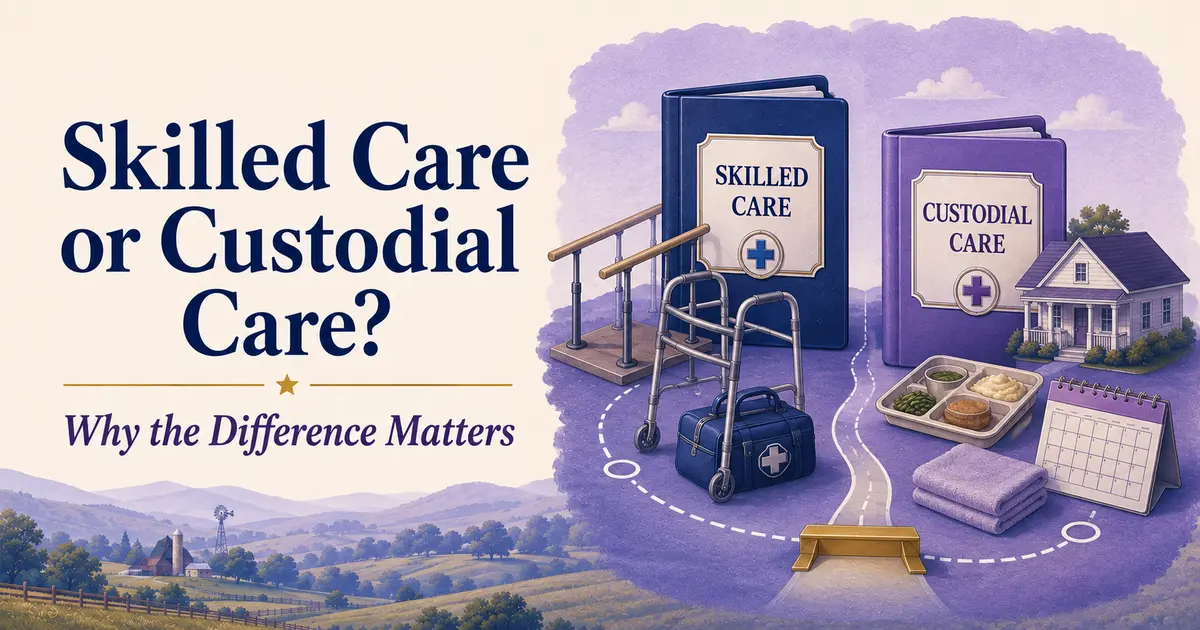
Side-by-side
What makes a service skilled or custodial?
| Skilled care examples | Custodial care examples |
|---|---|
| Complex wound care and clinical monitoring | Bathing, dressing, grooming and toileting |
| Injections or medication services requiring a nurse | Medication reminders without clinical administration |
| Physical, occupational or speech therapy | Meal preparation, shopping and housekeeping |
| Teaching a safe treatment procedure | Supervision, companionship and transportation |
The same person can need services in both columns. Medicare pays only when a covered skilled benefit’s complete requirements are met. For the detailed PT, OT and speech-language pathology rules, see Medicare Therapy Coverage.
Coverage decisions
Three Rules That Matter After the Care Setting Is Chosen
The Building Does Not Decide Coverage
Skilled services can occur in a hospital, skilled nursing facility, clinic or private home. Custodial care can occur in those same settings. A nursing-home resident does not automatically have Medicare-covered skilled nursing, and a person at home can receive covered skilled home health care while family supplies noncovered daily assistance.
Maintenance Care Can Still Be Skilled
Coverage can be appropriate when skilled services are needed to maintain function or prevent or slow deterioration. The test is whether the service is reasonable and necessary and requires qualified clinical skill—not whether the patient is expected to improve. Documentation should explain why the skilled professional is needed.
Get the Written Reason and Appeal Deadline
A provider may conclude that skilled services are no longer necessary, that a benefit requirement is not met or that the available benefit days have been used. Read the Notice of Medicare Non-Coverage or other notice immediately. Fast-appeal deadlines for ending skilled nursing, home health, rehabilitation or hospice services can be extremely short.
Planning
Translate the care plan into tasks
- Ask the clinician which tasks require licensed skill and why.
- Ask how often the skilled task is needed.
- Identify who will handle personal care between visits.
- Confirm the expected Medicare benefit and cost sharing.
- Begin Medicaid, veterans or community-resource screening before skilled coverage ends.
Frequently asked questions
Skilled or Custodial Care? Questions
Is feeding assistance skilled care?
Ordinary help eating is generally custodial. Skilled swallowing evaluation or therapy can be covered when medically necessary.
Is medication help skilled care?
Clinical administration or teaching can be skilled. Simple reminders or organizing ordinary pills are generally custodial tasks.
Can skilled care be covered if I am not improving?
Yes, when qualified clinical skill is needed to maintain function or prevent or slow deterioration and all other coverage rules are met.
Does a doctor’s order make custodial care covered?
No. An order is important, but the service must also fit a Medicare benefit and meet its medical-necessity and eligibility rules.
More Medicare guidance
Related Articles
Primary references
Official Sources
- Medicare.gov: Long-term care
- Medicare.gov: Skilled nursing facility care
- Medicare.gov: Home health services
- Medicare.gov: Fast appeals
Reviewed against official sources on August 22, 2026. Medicare and state program rules can change; verify current requirements before acting.
Independent Medicare guidance
Make the Next Decision With the Actual Details in Front of You
Benjamin Thompson can help compare the Medicare insurance options represented by Thompson Medicare Brokerage using your doctors, prescriptions, coverage priorities and budget.
Thompson Medicare Brokerage is not connected with or endorsed by the U.S. government or the federal Medicare program. This page provides general educational information. Coverage, costs, eligibility, networks, formularies and enrollment rights depend on individual facts, location, plan and coverage year. Thompson Medicare Brokerage does not offer every plan available in every area; Medicare.gov, 1-800-MEDICARE and SHIP can provide information about all available options.