
Temporary Medicare weight-management program
Medicare GLP-1 Bridge: $50 GLP-1 Drugs for Weight Loss
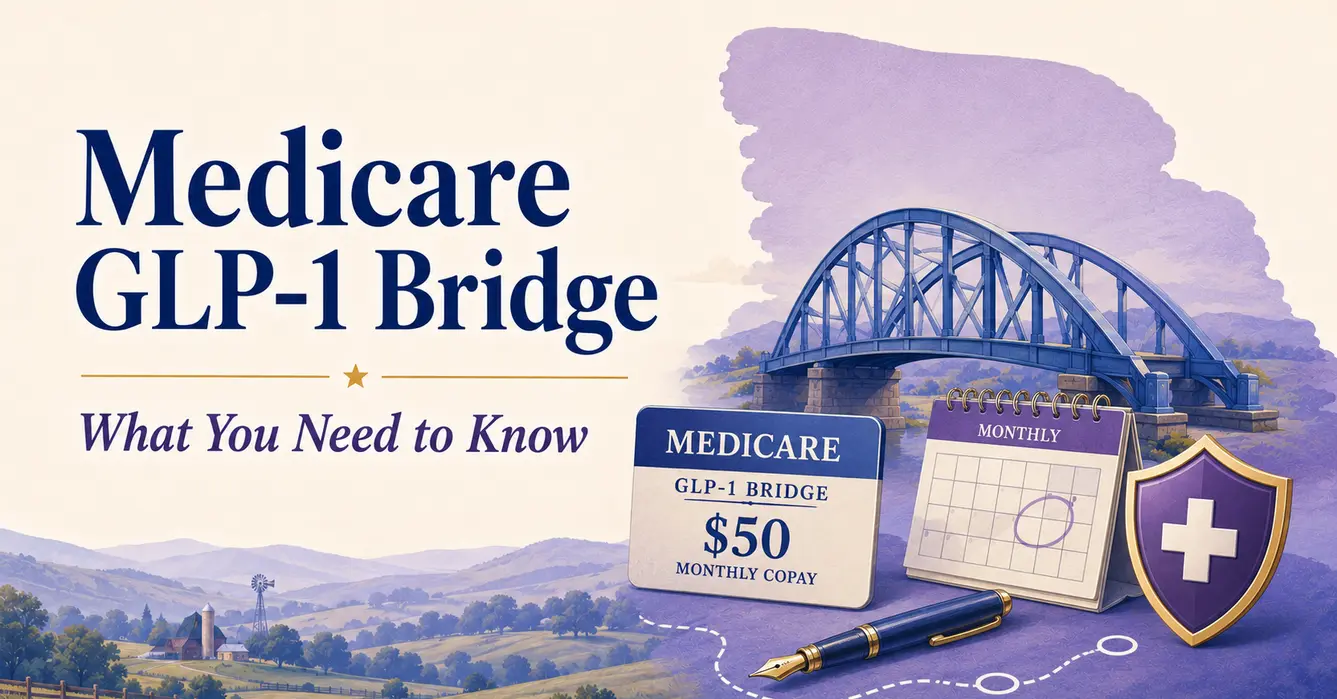
Certain adults with eligible Part D coverage can obtain selected weight-management GLP-1 drugs for a $50 copay per one-month supply from July 1, 2026, through December 31, 2027.
How to check your coverage. Ask your prescriber whether your drug and the reason you take it qualify for the Bridge. You need eligible Medicare Part D coverage, but the Bridge processes approved prescriptions separately from your usual Part D benefit.
Medicare GLP-1 Bridge at a Glance
$50 one-month supply
Eligible beneficiaries pay $50 for a 28- or 30-day supply, regardless of income.
Part D required
You must be enrolled in an eligible Part D plan. Other creditable drug coverage by itself does not satisfy this requirement.
What does creditable drug coverage mean?
Drug coverage expected to pay at least as much, on average, as standard Medicare drug coverage. Your coverage provider can tell you whether yours qualifies. How to check your drug coverage.
Temporary program
The Bridge runs from July 1, 2026, through December 31, 2027, under current CMS guidance.
The Bridge is not ordinary Part D formulary coverage. Its $50 payment does not satisfy the Part D deductible or count toward the annual out-of-pocket limit, and it cannot be placed in the Medicare Prescription Payment Plan.
Which coverage qualifies? Current CMS guidance includes standalone prescription drug plans (PDPs) and Medicare Advantage coordinated care plans with Part D: HMO, HMO-POS, and local or regional PPO plans. Eligible coverage also includes Special Needs Plans (SNPs), employer/union group waiver plans (EGWPs) and the Limited Income Newly Eligible Transition (LI NET) program.
Private fee-for-service plans, Medicare Cost Plans, health care prepayment plans, PACE organizations, fallback plans and religious fraternal benefit plans do not qualify by themselves; an eligible standalone PDP may permit participation where that combination is allowed. VA, TRICARE or non-Part-D retiree drug coverage alone is not Part D. An EGWP that provides Part D is different. Before adding or changing Part D, confirm enrollment rights and the effect on existing benefits. If you are in PACE, joining a standalone Part D plan disenrolls you from PACE. Talk with your PACE team before making an election. A private fee-for-service Medicare Advantage plan without drug coverage may instead be paired with a standalone Part D plan.
Who May Qualify?
The provider must prescribe the drug for weight reduction and maintenance together with an ongoing lifestyle program, and the adult must meet a qualifying BMI and health-condition pathway when GLP-1 therapy began. You must be at least 18. Use measurements from when GLP-1 treatment began, even if that was before Medicare enrollment or before the Bridge started. Your prescriber documents nutrition and physical activity; the CMS authorization form allows an exception when physical activity is clinically inappropriate.
| BMI pathway | Additional listed condition |
|---|---|
| BMI of 35 or higher | No additional listed condition is required under this pathway. |
| BMI of 30 or higher | At least one of these conditions: heart failure with preserved ejection fraction, chronic kidney disease stage 3a or higher, or systolic blood pressure above 140 mm Hg or diastolic pressure above 90 mm Hg despite taking two blood pressure medicines at the same time. |
| BMI of 27 or higher | At least one of these conditions: prediabetes as defined by the American Diabetes Association, a past heart attack, a past stroke or symptomatic peripheral artery disease (reduced blood flow to the limbs). |
Official criteria are more detailed than this summary. The provider must use current Medicare instructions and attest to the required information.
Who Does Not Qualify for the Bridge?
Meeting a BMI pathway does not automatically make someone eligible. CMS also applies exclusions designed to keep ordinary Part D-covered GLP-1 treatment inside the Part D benefit instead of moving it into the Bridge.
Specific diagnosis exclusions
CMS excludes beneficiaries with type 2 diabetes, moderate-to-severe obstructive sleep apnea, or noncirrhotic metabolic dysfunction-associated steatohepatitis (MASH) with moderate-to-advanced fibrosis. These exclusions apply even if the person’s current Part D plan does not cover a GLP-1 for that condition.
GLP-1 received through Part D in 2026
If your Part D plan paid for a GLP-1 prescription at any point in 2026, you do not qualify for Bridge coverage in 2026, even for a later prescription for weight management. As of November 19, 2026, CMS has not announced how far back it will check Part D use for 2027. See the current CMS eligibility guidance before making a 2027 coverage decision. For this 2026 check, the CMS consumer guide names semaglutide, tirzepatide, orforglipron, dulaglutide and liraglutide. A self-paid fill alone does not establish a Part D-paid claim.
Bridge and Part D are separate coverage paths. Established cardiovascular disease alone is not one of the three diagnosis exclusions above, and certain cardiovascular histories appear in the Bridge eligibility pathways. However, if a GLP-1 is prescribed to reduce the risk of major adverse cardiovascular events, the prescription must be pursued through Part D, even if weight management is also a treatment goal. The prescriber should identify the intended use and follow the appropriate formulary, prior-authorization or exception process.
Which GLP-1 Drugs Are Included?
As of August 2026, Medicare lists the following products for qualifying Bridge use. The list may change during the temporary program.
| Drug | Bridge formulation | Important limitation |
|---|---|---|
| Foundayo® | Tablet | Must be prescribed for qualifying Bridge weight-management use. |
| Wegovy® | Injection or tablet | Ordinary Part D rules apply when prescribed for a Part D-covered indication. |
| Zepbound® | KwikPen® only | Single-dose vials and pens are not covered through the Bridge. |
Pen needles for the Zepbound KwikPen are purchased separately and are not covered by the Bridge. A purchase of pen needles may therefore bring your total at pickup above the $50 drug price.
How Do the Cost Rules Differ?
| Cost question | Bridge rule |
|---|---|
| Copay | $50 for a 28- or 30-day supply |
| Part D deductible | Does not apply to the Bridge fill |
| Part D out-of-pocket cap | The $50 does not count toward the Part D limit in either year ($2,100 in 2026 and $2,400 in 2027). |
| Extra Help | Does not reduce the Bridge copay below $50 |
| Prescription Payment Plan | Bridge fills are not eligible |
| Extended supply | 60- and 90-day fills are not available through the Bridge |
See Part D costs in 2026 for the ordinary deductible and out-of-pocket rules.
How Does Someone Request Bridge Coverage?
- The medical provider decides whether a listed GLP-1 is appropriate and whether the person appears to meet the criteria.
- The provider prescribes the covered product for qualifying weight-management use.
- The pharmacy routes the claim through the Bridge process. The prescriber should generally wait for the pharmacy-generated prior-authorization request before submitting the authorization.
- The provider completes the required prior authorization with the clinical information.
- CMS generally mails the decision to the beneficiary and sends it electronically or by fax to the prescriber within 72 hours of submission. Postal delivery can take longer.
- If your approved one-month supply costs more than $50, ask the pharmacist, “Did this go through the Medicare GLP-1 Bridge or my Part D plan?” The pharmacist can check the Bridge billing codes, BIN 028918 and PCN MEDDGLP1BR, before you pay. Ask the pharmacy to process the approved claim before paying cash. Medicare does not reimburse you directly for a cash purchase. CMS pharmacy billing guidance explains how the pharmacy submits the claim.
What can stop a refill? Even after approval, a pharmacy can reject a Bridge refill if you later fill a GLP-1 prescription through Part D or switch to a plan type that does not qualify for the Bridge. CMS explains when Bridge refills can be denied.
The Bridge does not provide a formal appeal process. If information was incorrect, incomplete or changed, the prescriber can submit the prior-authorization request again with corrected information.
Medicare GLP-1 Bridge Questions
Does the Bridge cover Ozempic or Mounjaro?
No. As of August 2026, Medicare lists Foundayo, Wegovy and the Zepbound KwikPen for qualifying Bridge use. Other GLP-1 drugs may be covered by Part D for Medicare-covered indications.
Can someone with Original Medicare qualify?
Yes, if the person also has an eligible standalone Part D plan and meets all other Bridge requirements.
Can someone with Medicare Advantage qualify?
Yes, if the plan is an eligible coordinated care MA-PD plan, such as an HMO, HMO-POS or local or regional PPO, and all other Bridge requirements are met. SNPs can qualify. Other Medicare health-plan types have different eligibility rules; review the coverage list above and confirm your exact plan before relying on the Bridge.
Can I use the Bridge if I received a GLP-1 through Part D earlier in 2026?
No. A GLP-1 fill covered by your Part D plan in 2026 rules out Bridge coverage for the rest of 2026. If you are applying for 2027, check the CMS rules for prior Part D use.
What if I have diabetes, sleep apnea or MASH?
Type 2 diabetes, moderate-to-severe obstructive sleep apnea and qualifying noncirrhotic MASH with moderate-to-advanced fibrosis each exclude a person from the Bridge. That exclusion still applies if their drug plan does not cover the prescription. Ask the prescriber and plan about Part D coverage or an exception. For cardiovascular disease, eligibility depends on the intended use of the prescription.
What if my prescriber hasn’t received the authorization request from the pharmacy?
Ask the pharmacy when it sent the request. If your prescriber still hasn’t received it after 72 hours, the prescriber can download the fax form from the CMS instructions for providers and submit it directly.
How long does a Bridge approval last?
If you remain eligible, your approval covers refills and dose changes of the same drug through December 31, 2027. Switching to a different Bridge drug requires a new authorization.
Does Extra Help lower the $50 copay?
No. The Bridge copay is $50 regardless of income, and the payment does not count toward ordinary Part D out-of-pocket spending.
Can a Bridge drug use the Prescription Payment Plan?
No. Bridge drugs are not eligible for Medicare Prescription Payment Plan billing.
Who decides whether I qualify?
The provider supplies the clinical information and Medicare administers the authorization. Thompson Medicare Brokerage does not make medical or eligibility decisions.
Independent Medicare guidance
Compare Part D Coverage Using Your Actual Prescriptions
I can check how your other prescriptions are covered under the Part D plans I represent. For Bridge eligibility and authorization, ask your prescriber about the program’s requirements.
This page provides general educational information and is not medical advice. Plan availability, formularies, pharmacy networks, premiums, cost sharing, restrictions and enrollment rights vary by plan, location and year. Check current plan documents and official Medicare information.