
Your category controls the answer
Full-Benefit vs. Partial-Benefit Dual Eligibility
“Dual eligible” can mean full Medicaid benefits, limited help with Medicare premiums, or QMB protection from Medicare cost sharing. The exact category affects bills, services and D-SNP eligibility.
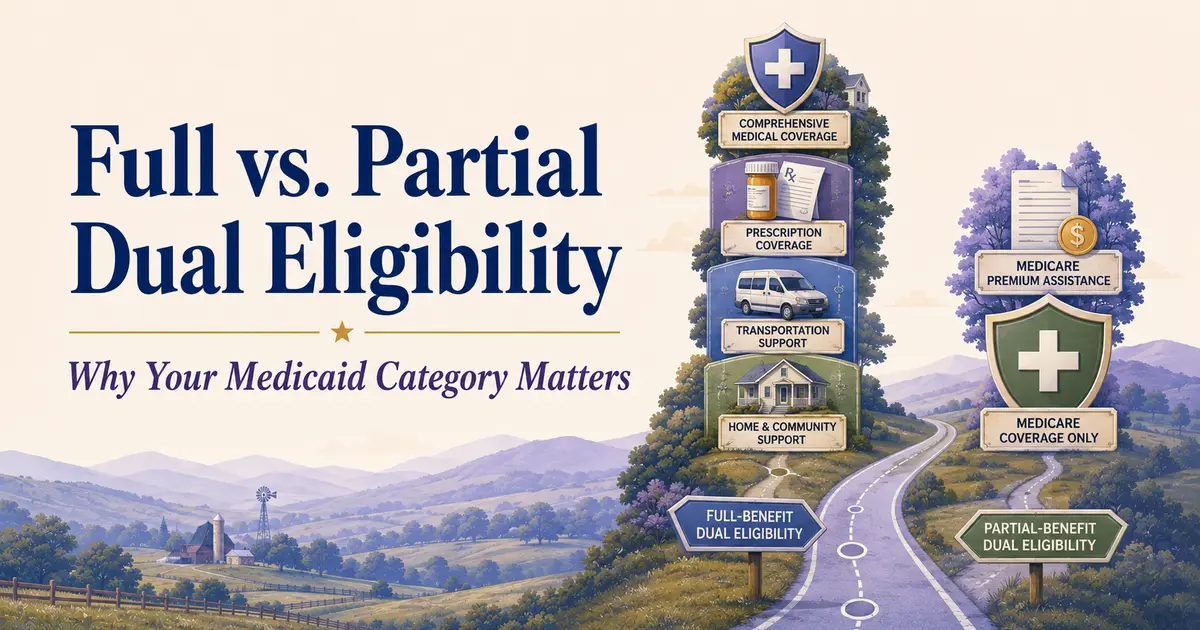
A Medicaid card does not reveal the entire benefit level
States assign specific eligibility categories and transmit them to Medicare. Two people may both say they have Medicare and Medicaid while receiving very different help.
Full-benefit dual eligible
The person receives Medicare plus the full Medicaid benefit package available under the qualifying state category.
Partial-benefit dual eligible
The person receives limited Medicaid-administered help with Medicare premiums or cost sharing rather than full Medicaid services.
Common dual-eligibility categories
| Category | General assistance | Full Medicaid? | D-SNP implication |
|---|---|---|---|
| QMB Plus | Applicable Part A premium, Part B premium, Medicare cost sharing and full Medicaid benefits | Yes | Often eligible for plans designed for full-benefit dual members, subject to plan rules |
| QMB-only | Applicable Part A premium, Part B premium and Medicare cost-sharing protection | No | May qualify for D-SNPs that accept QMB-only members |
| SLMB Plus | Part B premium and full Medicaid benefits | Yes | May qualify for full-benefit D-SNPs depending on the plan contract |
| SLMB-only | Part B premium | No | Only plans accepting SLMB-only may enroll the person |
| QI | Part B premium | No | D-SNP eligibility depends on whether the plan accepts QI |
| Other full-benefit dual | Full Medicaid benefits; Medicare cost-sharing treatment depends on category and state rules | Yes | May qualify for full-benefit D-SNPs |
Why the distinction matters at the doctor
QMB creates a specific federal billing protection
QMB-only and QMB Plus members may not be billed Medicare Part A or Part B cost sharing for Medicare-covered services. That rule does not automatically extend to an SLMB-only or QI member merely because the person receives some Medicaid-administered assistance.
Full Medicaid may cover services Medicare does not
Depending on the state and eligibility category, Medicaid may cover services such as long-term services and supports, personal care or non-emergency transportation. The provider may need to be enrolled with the state Medicaid program for Medicaid-covered services.
Medicare rules still come first for Medicare-covered care
Under Original Medicare, confirm Medicare participation. Under Medicare Advantage or a D-SNP, follow the exact network, referral and prior-authorization rules. Dual eligibility does not erase the Medicare plan’s rules.
How dual level affects D-SNP enrollment
A D-SNP’s contract specifies which dual-eligibility categories it may accept. Some plans are limited to full-benefit dual members. Others may accept QMB-only, SLMB-only or additional partial-benefit categories.
Even when someone qualifies, the D-SNP still needs to fit the person’s doctors, hospitals, prescriptions, pharmacies and care needs. Use the D-SNP comparison checklist before enrolling.
How to confirm your exact status
- Find the most recent state Medicaid or Medicare Savings Program approval notice.
- Look for a specific category such as QMB, SLMB, QI, QMB Plus or full Medicaid.
- Call the state agency if the notice only says “Medicaid” or the category is unclear.
- Ask for the effective date and whether the status includes full Medicaid benefits.
- Give the exact category—not only “I have Medicaid”—when comparing D-SNPs.
Dual-eligibility level FAQ
Is QMB-only full Medicaid?
No. QMB-only provides Medicare premium and cost-sharing assistance but not the full Medicaid benefit package. QMB Plus includes both QMB help and full Medicaid.
Is SLMB the same as Medicaid?
SLMB is administered through Medicaid and generally pays the Part B premium. SLMB-only does not provide the full package of Medicaid services.
Can partial-benefit dual members join a D-SNP?
Sometimes. The exact D-SNP must accept the person’s eligibility category. Some plans require full-benefit status.
Does full Medicaid mean every Medicare copay is automatically $0?
Not necessarily. QMB has a specific federal Medicare cost-sharing protection. Other full-benefit categories can work differently depending on the service and state rules.
Can dual status change during the year?
Yes. Renewals, income, resources, household changes or state redeterminations can change the category or end eligibility. Read every state and plan notice.
Related dual-eligibility and Medicare guides
Compare coverage using the exact eligibility category
Benjamin Thompson can help confirm which D-SNPs accept a reported category and compare the Medicare plan details. The state Medicaid agency remains responsible for determining the category itself.
This article provides general educational information and does not determine Medicaid, Medicare Savings Program, Extra Help or D-SNP eligibility. Program rules, limits, benefits, networks, formularies and enrollment rights can change. Verify the exact person’s status with Medicare, the applicable state Medicaid agency and the plan before changing coverage. Thompson Medicare Brokerage is not connected with or endorsed by the U.S. government or the federal Medicare program.