
Help with Medicare costs
Medicare Savings Programs Explained: QMB, SLMB, QI and QDWI
Medicare Savings Programs are state-administered programs that can help eligible people pay Medicare premiums. QMB can also protect a beneficiary from Medicare deductibles, copayments and coinsurance.
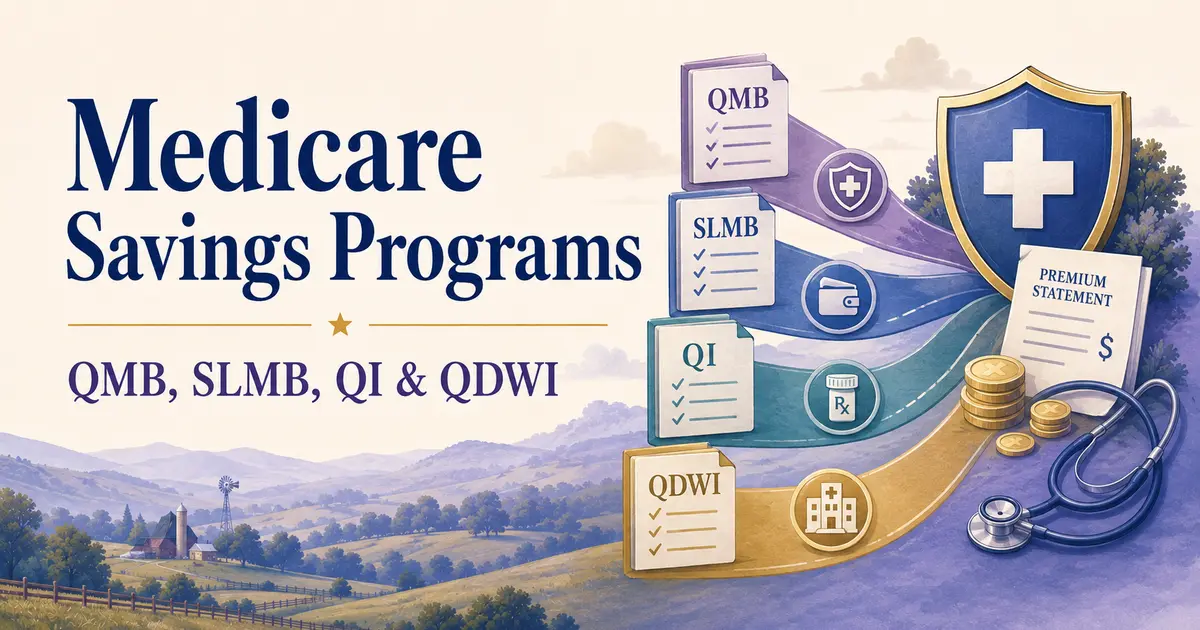
These four programs do not provide the same help
QMB offers the broadest Medicare help
QMB can pay applicable Part A and Part B premiums and protects the member from Medicare cost sharing for covered Part A and Part B services.
SLMB and QI focus on Part B
SLMB and QI generally pay the Part B premium. They do not create QMB’s federal protection from Medicare deductibles, copayments and coinsurance.
QDWI is a narrower program
QDWI can help certain disabled working people pay the Part A premium after premium-free Part A ends because they returned to work.
The state makes the decision
You apply through your state. States may use rules that allow some applicants to qualify above the federal figures shown below.
Income and resource limits
These are the federal 2026 figures published by Medicare. Income-counting rules, exclusions and state policies matter, so use the table as a screening tool—not a self-denial tool.
| Program | What it generally pays | Individual | Married couple |
|---|---|---|---|
| QMB | Applicable Part A premium, Part B premium and Medicare Part A/B cost sharing | $1,350 monthly income $9,950 resources | $1,824 monthly income $14,910 resources |
| SLMB | Part B premium | $1,616 monthly income $9,950 resources | $2,184 monthly income $14,910 resources |
| QI | Part B premium | $1,816 monthly income $9,950 resources | $2,455 monthly income $14,910 resources |
| QDWI | Part A premium for certain disabled working people | $5,405 monthly income $4,000 resources | $7,299 monthly income $6,000 resources |
Limits are higher in Alaska and Hawaii. Medicare also advises people to apply even when they are unsure, because some income or resources may not count and state rules can be more generous.
What each Medicare Savings Program changes
QMB: premiums plus Medicare cost-sharing protection
QMB is the category that changes both premium responsibility and medical cost sharing. Medicare providers and suppliers may not bill a QMB member for Medicare-covered Part A or Part B deductibles, copayments or coinsurance. That protection applies under Original Medicare and Medicare Advantage. Read the separate QMB billing-protection guide if an office sends a bill.
SLMB: help with the Part B premium
SLMB generally pays the Part B premium. SLMB-only status is not the same as full Medicaid and does not eliminate Medicare medical cost sharing in the way QMB does.
QI: Part B help that must be renewed
QI generally pays the Part B premium. Medicare states that QI applications are handled on a first-come, first-served basis, with priority for people who received QI the previous year. QI recipients must reapply annually.
QDWI: help with a specific Part A premium problem
QDWI is designed for certain people under 65 who remain disabled and working but lost premium-free Part A after returning to work. It is not the ordinary MSP path for most retirees.
How MSP approval affects Extra Help and D-SNP eligibility
Extra Help
People receiving help from a state with the Part B premium through an MSP generally qualify automatically for Medicare Part D Extra Help. Extra Help still requires Part D coverage and does not make every prescription covered.
Review Extra Help and MSP coordination →D-SNP eligibility
Some D-SNPs accept QMB-only, SLMB-only or other partial-benefit categories; others require full Medicaid. Qualification does not make a D-SNP automatically appropriate or available; first review how D-SNP eligibility, coordination and plan fit work.
Compare full and partial dual eligibility →How to apply in Missouri or Illinois
- Gather current information. Keep your Medicare card, Social Security and pension information, bank information and documents showing other income or resources.
- Apply through the state. Missouri residents can use the Family Support Division’s MSP application. Illinois residents can use the dedicated Illinois Medicare Savings Programs guide for current Illinois limits and ABE application steps.
- Ask for the exact category in writing. “Medicaid” is not specific enough. Save the approval notice identifying QMB, SLMB, QI, full Medicaid or another category.
- Check the effective date. A delay in the Part B premium returning to the Social Security payment does not necessarily mean the application was denied.
- Use the approved status when comparing plans. Verify whether a D-SNP accepts the exact category and whether the plan fits the person’s providers and prescriptions.
If Missouri says you may qualify through spend down, read the Missouri spend-down guide to understand the monthly amount and when coverage becomes active. Spend down and Medicare Savings Programs have different rules.
Medicare Savings Program FAQ
Is a Medicare Savings Program the same as Medicaid?
An MSP is administered through Medicaid, but limited-benefit categories such as SLMB-only or QI do not provide the full package of Medicaid benefits. Ask the state to identify the exact category.
Can an MSP pay my Part B premium?
QMB, SLMB and QI can pay the Part B premium when approved. QDWI is different and focuses on the Part A premium for certain disabled working people.
Does QMB eliminate every healthcare charge?
No. QMB protection applies to Medicare cost sharing for Medicare-covered Part A and Part B services. Part D copayments, non-covered services and a legally permitted small Medicaid copayment can still apply.
Should I apply if my income looks slightly too high?
Yes. Medicare advises people to apply because states can use different counting rules and may allow qualification above the federal figures.
Does MSP approval automatically enroll me in a D-SNP?
No. MSP status may make someone eligible for certain D-SNPs, but enrollment is separate and the exact plan must accept the person’s eligibility category.
Official sources
- Medicare.gov: Medicare Savings Programs and 2026 limits
- CMS: Dual Eligibility Categories, revised February 11, 2026
- Missouri DSS: Medicare Savings Program application information
- Illinois HFS: HFS 3757 Medicare cost-sharing brochure — 2023 general background. Its older savings figure is not a current-year amount. Use the Illinois Medicare Savings Programs guide and its current official sources for program-year limits and benefits.
Independent Medicare guidance
Make sure the assistance and Medicare plan work together
Benjamin Thompson can help you understand how a confirmed MSP category affects Medicare plan choices, costs, doctors and prescriptions. Missouri or Illinois—not Thompson Medicare Brokerage—makes the eligibility decision.
This article provides general educational information and does not determine Medicaid, Medicare Savings Program, Extra Help or D-SNP eligibility. Program rules, limits, benefits, networks, formularies and enrollment rights can change. Verify the exact person’s status with Medicare, the applicable state Medicaid agency and the plan before changing coverage. Thompson Medicare Brokerage is not connected with or endorsed by the U.S. government or the federal Medicare program.