
Medicare and Medicaid Coordination
What Is a D-SNP?
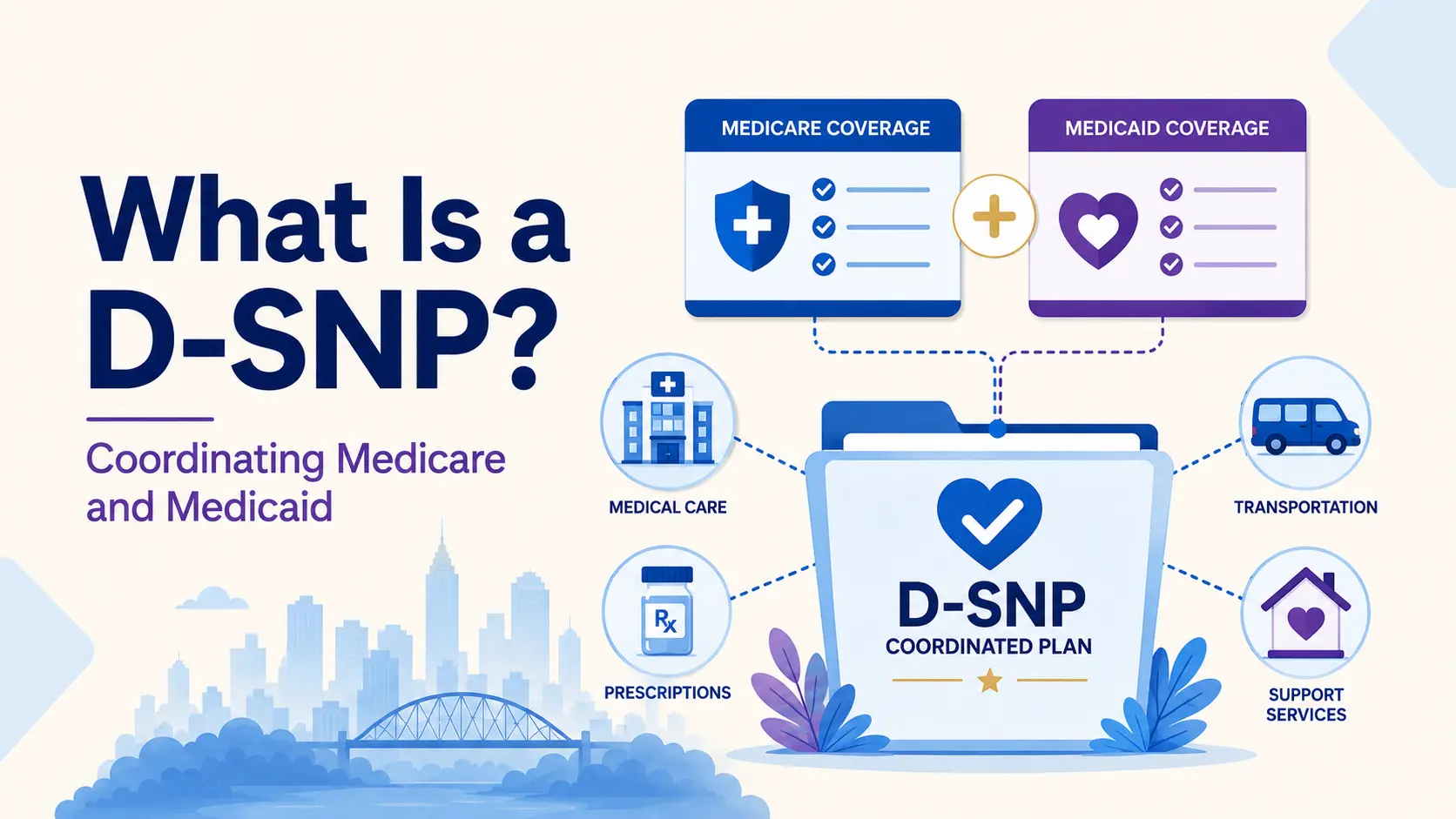
A Dual Eligible Special Needs Plan is a specialized Medicare Advantage plan for people who qualify for both Medicare and Medicaid.
How Does a D-SNP Work?
Medicare and Medicaid are separate programs. Medicare generally pays first for Medicare-covered healthcare, while Medicaid may help with premiums, cost sharing and additional services according to the beneficiary’s Medicaid eligibility.
A D-SNP administers Medicare Part A and Part B benefits through a private Medicare Advantage plan. It must also include Medicare Part D prescription drug coverage and contract with the state Medicaid program to coordinate benefits.
Who Can Qualify for a D-SNP?
To enroll in a particular D-SNP, you generally must meet all of the following requirements:
Have Medicare
You must generally be enrolled in both Medicare Part A and Medicare Part B and continue paying any Part B premium that is not paid on your behalf.
Have Qualifying Medicaid
You must have a Medicaid or Medicare Savings Program eligibility category accepted by the particular D-SNP.
Live in the Service Area
You must live in a county served by the plan and satisfy any Medicaid managed-care alignment requirements.
Full-Benefit and Partial-Benefit Dual Eligibility
“Dual eligible” does not describe one single level of coverage. Some people receive full Medicaid benefits, while others receive help with specific Medicare premiums or cost sharing through a Medicare Savings Program.
| Eligibility Category | General Assistance | D-SNP Consideration |
|---|---|---|
| Full-Benefit Dual Eligible | Receives Medicare and a broader package of state Medicaid benefits. | May qualify for D-SNPs designed for full-benefit dual members, including integrated D-SNPs where available. |
| QMB Plus | Receives full Medicaid benefits plus protection from Medicare deductibles, copayments and coinsurance. | Commonly eligible for plans serving full-benefit dual members, subject to plan and service-area rules. |
| QMB Only | Medicaid helps with Medicare premiums and Medicare-covered deductibles, copayments and coinsurance. | May qualify for a D-SNP that accepts QMB-only members, but does not receive the same broader Medicaid benefits as a full-benefit dual member. |
| SLMB Plus | Receives full Medicaid benefits and help with the Medicare Part B premium. | May qualify for plans serving full-benefit dual members, depending on the plan contract. |
| SLMB Only | Medicaid generally pays the Medicare Part B premium. | May qualify for certain D-SNPs, but Medicare medical cost sharing is not automatically eliminated by SLMB-only status. |
| QI or QDWI | Provides limited help with an applicable Medicare premium. | Eligibility for a D-SNP depends on whether the plan accepts that particular category. |
What Does a D-SNP Include?
Medicare Part A and Part B
The D-SNP provides all Medicare-covered hospital and medical benefits. Like other Medicare Advantage plans, it may use provider networks, referrals, prior authorization and plan-specific coverage rules.
Medicare Part D
All Special Needs Plans must include Medicare prescription drug coverage. Each D-SNP has its own formulary, pharmacy network, drug tiers and coverage requirements.
Care Coordination
Plans may provide a care coordinator, individualized care plan, health-risk assessment and assistance communicating among doctors, facilities, pharmacies and Medicaid programs.
Additional Plan Benefits
Depending on the plan, additional benefits may include dental, vision, hearing, transportation, over-the-counter products, meals or other support services.
Does the D-SNP Provide All Medicaid Benefits?
Not necessarily. Some D-SNPs closely integrate Medicare and Medicaid, while others primarily coordinate information between two separately administered programs.
Medicaid benefits may include services Medicare does not normally cover, such as certain long-term services and supports, personal care or non-emergency transportation. The benefits available depend on:
- Your Medicaid eligibility category
- Your state’s Medicaid program
- Whether you are enrolled in Medicaid managed care
- Whether the D-SNP is aligned with that Medicaid organization
- The type of D-SNP integration
- Service-specific Medicaid eligibility and authorization rules
What Is an Integrated D-SNP?
Integrated D-SNPs are designed to coordinate Medicare and Medicaid more closely. The terminology can be complicated, but the practical difference is how much responsibility the organization has for coordinating or administering benefits from both programs.
Coordination-Only D-SNP
Coordinates certain Medicare and Medicaid information, but the two programs may remain more separate. Medicaid services may be administered by the state or another organization.
HIDE SNP
A Highly Integrated D-SNP has a greater level of coordination with Medicaid, including certain Medicaid behavioral-health services, long-term services and supports, or both.
FIDE SNP
A Fully Integrated D-SNP provides one of the highest levels of Medicare and Medicaid integration through aligned plan arrangements. The exact Medicaid benefits included still depend on the state contract.
The plan name alone does not tell you whether your own doctors, prescriptions and Medicaid services will work properly. The exact Medicare and Medicaid arrangements should be verified before enrollment.
Does a D-SNP Mean Everything Is Free?
No. Many D-SNP members have very low medical costs because Medicaid or a Medicare Savings Program helps with Medicare expenses. However, the amount you owe depends on your Medicaid category, the service, the provider and the plan.
- You must remain enrolled in Medicare Part A and Part B
- The Medicare Part B premium still exists, even if Medicaid pays it
- Prescription copayments may apply under Medicare Extra Help
- Non-covered services can remain your responsibility
- Using an out-of-network provider can affect coverage
- Partial-benefit dual members may have different costs than full-benefit members
What Should Be Checked Before Enrolling?
A D-SNP should be compared using the member’s complete healthcare and Medicaid situation—not merely its extra-benefit allowances.
- The exact Medicaid eligibility category
- Whether the plan accepts that Medicaid category
- Primary care physicians and specialists
- Hospitals, rehabilitation facilities and laboratories
- Dialysis facilities and durable medical equipment suppliers
- Every prescription, dosage and preferred pharmacy
- Prior authorization and referral requirements
- Medicare and Medicaid provider participation
- Long-term care or home-based service arrangements
- Transportation rules and scheduling requirements
- Dental, vision, hearing and over-the-counter benefit details
- The plan’s relationship with the Medicaid managed-care organization
When Can You Join or Change a D-SNP?
People with Medicaid or Medicare Extra Help may have additional enrollment opportunities, but dual eligibility does not provide unlimited monthly switching among every Medicare Advantage plan.
Integrated Care Special Enrollment Period
Qualifying full-benefit dual members may generally use the Integrated Care Special Enrollment Period once per calendar month to join or switch to an eligible integrated D-SNP.
When required, the D-SNP enrollment must align with an affiliated Medicaid managed-care organization. Not every D-SNP qualifies for this monthly enrollment opportunity.
Dual and Extra Help Special Enrollment Period
Eligible beneficiaries may generally use the separate monthly Dual/LIS Special Enrollment Period to return to Original Medicare with a standalone Part D plan or switch between standalone Part D plans.
This SEP does not provide a general monthly right to select any regular Medicare Advantage plan or any coordination-only D-SNP.
Other enrollment opportunities may include the Initial Coverage Election Period, the October 15–December 7 Annual Enrollment Period, the Medicare Advantage Open Enrollment Period and Special Enrollment Periods triggered by changes in Medicaid eligibility, residence or other qualifying circumstances.
Illinois FIDE D-SNPs in 2026
Illinois previously operated the Medicare-Medicaid Alignment Initiative, commonly called MMAI. That program ended on December 31, 2025.
Beginning January 1, 2026, Illinois moved to Fully Integrated Dual Eligible Special Needs Plans, or FIDE SNPs, for qualifying beneficiaries who want integrated Medicare and Medicaid coverage.
Illinois beneficiaries should verify:
- Their current Medicare plan enrollment
- Their Illinois Medicaid managed-care organization
- Whether the Medicare and Medicaid plans are properly aligned
- Doctors, hospitals, prescriptions and pharmacies
- Long-term care and home-based service arrangements
- Which card or cards should be presented to providers
D-SNP Coverage in Missouri
Missouri D-SNP availability varies by county, insurance company and Medicaid category. A plan available in Springfield may not be available in Texas County, and two plans offered in the same county may accept different levels of Medicaid eligibility.
Before enrolling, Missouri beneficiaries should verify their MO HealthNet status, Medicare Savings Program category, providers, prescriptions and how the D-SNP will coordinate with any separately administered Medicaid services.
A person whose Medicaid has recently become inactive should not assume a D-SNP will continue providing the same cost sharing or additional benefits indefinitely. Medicaid eligibility should be confirmed and corrected promptly when appropriate.
What Happens If You Lose Medicaid?
D-SNP eligibility depends on maintaining an accepted level of Medicaid. Plans may provide a temporary period to regain eligibility, but the rules and length of that period vary.
During or after a loss of Medicaid:
- Your medical cost-sharing responsibility may change
- Certain additional benefits may change or end
- You may eventually be disenrolled from the D-SNP
- You may receive a Special Enrollment Period to select other coverage
- You may need to reapply for Medicaid or a Medicare Savings Program
D-SNP Questions
What does D-SNP stand for?
D-SNP stands for Dual Eligible Special Needs Plan. It is a Medicare Advantage Special Needs Plan for people who qualify for both Medicare and an accepted level of Medicaid assistance.
Does every person with Medicaid qualify for a D-SNP?
No. The person must have Medicare Part A and Part B, live in the plan’s service area and have a Medicaid category accepted by that particular D-SNP.
Does a D-SNP include prescription coverage?
Yes. All Medicare Special Needs Plans must include Medicare Part D prescription drug coverage. Formularies, pharmacies and coverage rules vary by plan.
Can a person with QMB be billed for Medicare cost sharing?
Providers are not permitted to bill QMB members for Medicare-covered deductibles, copayments or coinsurance. A small Medicaid copayment may apply in limited circumstances where permitted.
Are all D-SNP medical copayments $0?
No. A person’s responsibility depends on the Medicaid category, plan, provider and service. Full-benefit and QMB members often have strong cost-sharing protection, while other eligibility categories may work differently.
Can I use any doctor with a D-SNP?
Usually not. D-SNPs are Medicare Advantage plans and commonly use provider networks. The doctor may also need to participate properly with Medicaid for Medicaid-covered services or cost-sharing coordination.
Can someone change D-SNPs every month?
Not automatically. Qualifying full-benefit dual members may use the monthly Integrated Care SEP to join an eligible integrated D-SNP when applicable alignment requirements are met. Other D-SNP changes require another valid enrollment period.
Are grocery, utility or over-the-counter benefits guaranteed?
No. These benefits vary by plan and may have health-based eligibility requirements, approved uses, participating retailers, spending limits and expiration rules.
Do I lose Medicaid by joining a D-SNP?
No. A D-SNP coordinates with Medicaid but does not replace Medicaid eligibility. You must continue completing Medicaid renewals and meeting state eligibility requirements.
Is a D-SNP always better than Original Medicare?
No coverage approach is automatically right for everyone. Provider networks, prescriptions, Medicaid services, care coordination, costs and personal preferences should all be evaluated before enrollment.
Get Help Comparing D-SNP Coverage
Benjamin Thompson can help verify your Medicaid category, compare available D-SNPs and review your doctors, prescriptions, pharmacies, hospitals and additional benefits before you enroll.
Thompson Medicare Brokerage provides no-cost, no-obligation Medicare consultations throughout Missouri and Illinois, along with year-round assistance when eligibility or coverage problems arise.
This page provides general educational information. Medicaid eligibility, D-SNP availability, enrollment rights, provider networks, costs and benefits vary by state, county, plan, eligibility category and coverage year. Confirm individual eligibility and plan information with Medicare, the applicable state Medicaid agency or another appropriate resource before changing coverage.