
Choose How You Receive Medicare
Original Medicare vs. Medicare Advantage: Costs, Doctors, Networks and Coverage
Original Medicare and Medicare Advantage are the two main ways to receive Medicare Part A and Part B benefits. The choice affects how you access doctors and hospitals, how medical costs are structured, whether plan networks and prior authorization apply, how prescription coverage fits in, and what happens when you travel or move.
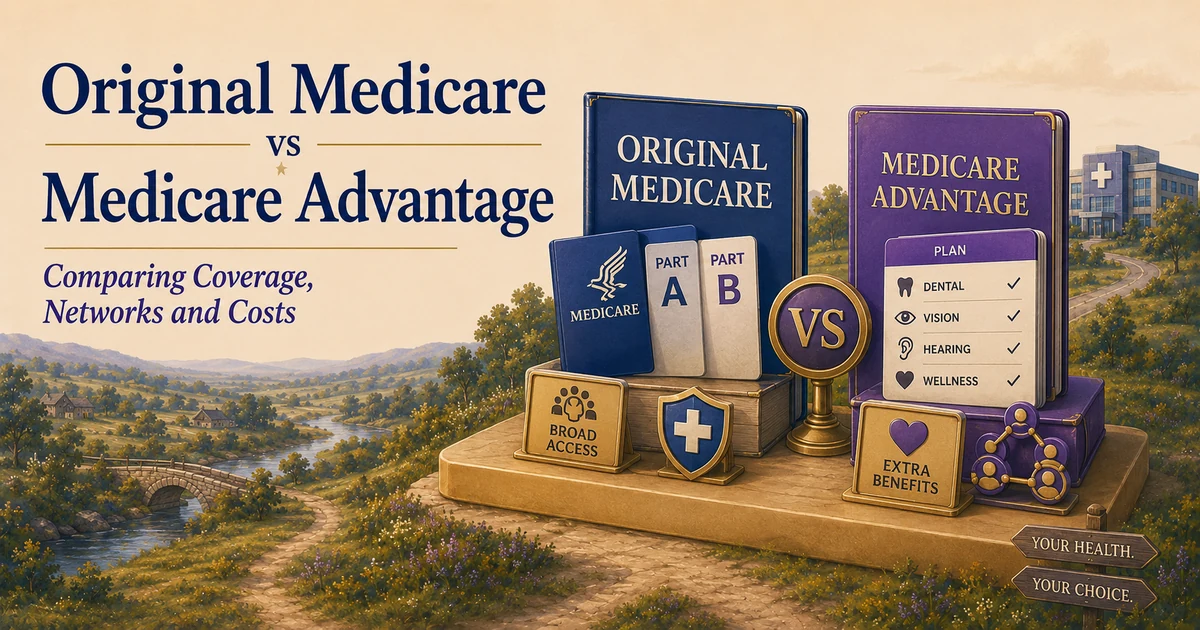
Quick answer: Original Medicare is the federal Part A and Part B program. You can generally use any U.S. doctor or hospital that takes Medicare, but Original Medicare by itself has no annual out-of-pocket maximum and broad outpatient prescription coverage usually requires a separate Part D plan. Medicare Advantage is a private Medicare-approved alternative for receiving Part A and Part B benefits. Plans commonly use provider networks, may require prior authorization or referrals, have plan-specific copays and an annual medical out-of-pocket limit, and most include Part D. Neither structure is automatically better for everyone.
Start with the structure
What Is the Difference Between Original Medicare and Medicare Advantage?
The choice is not whether to have Medicare. In either structure, you must be entitled to Medicare and Medicare remains the federal program behind your Part A and Part B benefits. The difference is how those benefits are administered.
Original Medicare
Original Medicare includes Part A hospital insurance and Part B medical insurance administered through the federal Medicare program. Providers bill Medicare directly for covered services.
Medicare Advantage
Medicare Advantage, also called Part C, is offered by private plans approved by Medicare. The plan administers your covered Part A and Part B services and sets its own network, cost-sharing and coverage-management rules within Medicare requirements.
Medicare Advantage is not a Medicare Supplement. A Medicare Supplement policy works with Original Medicare. Medicare Advantage is a different way to receive your Medicare-covered Part A and Part B services. If you are comparing Medicare Advantage specifically with Medigap, use the dedicated Medicare Advantage vs. Medicare Supplement guide.
Side-by-side comparison
Original Medicare vs. Medicare Advantage at a Glance
| Question | Original Medicare | Medicare Advantage |
|---|---|---|
| Who administers Part A and Part B? | Federal Medicare program | Private Medicare-approved plan |
| Doctors and hospitals | Generally any U.S. provider that takes Medicare and agrees to treat you | Plan network and service-area rules commonly apply for non-emergency care |
| Specialist referrals | Generally not required by Medicare | May be required depending on plan type |
| Prior authorization | No plan-level prior-authorization system for most routine Part A/B services; Medicare coverage rules still apply | Frequently required for certain services or supplies |
| Medical out-of-pocket limit | No annual limit for Part A and Part B costs by itself | Annual limit for covered Medicare medical services |
| Part D prescriptions | Usually added through a separate standalone Part D plan | Included in most Medicare Advantage plans |
| Extra routine benefits | Routine dental, vision and hearing are generally not covered by Original Medicare | Many plans offer plan-specific dental, vision, hearing or other extras |
| Supplemental coverage | May pair with Medigap if eligible and available | Cannot use Medigap to pay Medicare Advantage cost sharing |
This is the general national structure. Medicare Advantage benefits, networks, premiums and cost sharing vary by plan and county. Medigap availability, premiums and enrollment rights vary by state, carrier and applicant.
Doctor and hospital access
Which Option Gives You More Provider Flexibility?
Original Medicare usually provides broader routine provider access. Medicare says you can use any doctor or hospital that takes Medicare anywhere in the United States. You still need the provider to accept you as a patient, and how a provider handles Medicare assignment can affect what you owe.
Medicare Advantage plans commonly use networks. An HMO generally requires in-network routine care except for protected situations such as emergency or urgent care. A PPO typically allows out-of-network covered care at a higher cost, but the plan still has a defined network and service area.
Original Medicare may fit people who value broad access
This can matter if you use specialists in several cities, travel frequently within the United States, or want fewer routine questions about whether a doctor participates in a particular plan network.
Medicare Advantage can work well when the network fits
A strong local HMO or PPO network can work very well when your doctors, hospitals and other providers participate and you are comfortable with the plan’s rules.
Medical cost structure
How Do Out-of-Pocket Costs Differ?
Original Medicare and Medicare Advantage place financial risk in different places.
Original Medicare
You pay the applicable Part A and Part B deductibles and cost sharing. For many Part B services, the standard structure is 20% coinsurance after the Part B deductible when the provider accepts assignment. Original Medicare by itself has no annual cap on Part A and Part B out-of-pocket costs.
Some people add Medigap to reduce specified Original Medicare cost sharing.
Medicare Advantage
Plans use their own deductibles, copays and coinsurance for covered services. Every Medicare Advantage plan has an annual limit on what you pay for covered Medicare medical services; once you reach the applicable plan limit, the plan pays 100% for covered medical services for the rest of that calendar year.
Learn how the Medicare Advantage MOOP differs from a deductible →
Do not compare only monthly premium. A $0 additional-premium Medicare Advantage plan can still have copays and coinsurance when you use care. Original Medicare can look simple until you account for uncapped Part A and Part B cost sharing, a Part D premium and any Medigap premium you choose to add.
Prescription drugs
How Does Part D Fit Into Each Choice?
Original Medicare usually needs separate Part D
Original Medicare covers some drugs in specific Part A or Part B settings, but broad outpatient retail prescription coverage generally comes from a separate Medicare Part D plan.
Most Medicare Advantage plans bundle Part D
Most Medicare Advantage plans include prescription drug coverage. You still need to verify the exact formulary, pharmacy network, drug tiers and utilization rules because medical network fit does not guarantee prescription fit.
Coverage rules before care
What About Prior Authorization and Referrals?
Original Medicare has national and local coverage rules, medical-necessity requirements and documentation standards, but it generally does not operate like a private HMO or PPO with a separate plan network and plan-level authorization system for routine Part A and Part B care.
Medicare Advantage plans may require prior authorization before certain services or supplies are covered. Referral requirements depend on plan type; HMOs commonly use them for specialty care, while PPOs often do not.
Review Medicare Advantage prior-authorization and referral rules →
Extra benefits
Do Extra Benefits Make Medicare Advantage Better?
Many Medicare Advantage plans offer benefits that Original Medicare generally does not cover, such as routine dental, vision, hearing, fitness or other plan-specific extras. Those benefits can be valuable, but they should be evaluated after the core medical network, prescriptions, costs and coverage rules fit.
An extra benefit is only useful if you can realistically use it. Check allowances, covered services, provider or vendor networks, frequency limits and expiration rules. A generous-looking dental allowance should not outweigh a poor hospital network or weak prescription fit.
Travel and moving
Which Structure Is Better if You Travel or Live in More Than One Place?
Original Medicare’s broad U.S. provider access can be attractive for people who routinely receive care in multiple states. Medicare Advantage covers emergency and urgently needed services throughout the United States and its territories, but routine non-emergency care away from home depends on the plan type, network and service area. International coverage is separate: some plans offer a limited foreign emergency or urgent-care benefit, so check the plan documents before traveling abroad.
PPOs may provide out-of-network benefits at higher cost, and some plans advertise travel-related network arrangements, but those details must be checked under the exact plan. If you permanently move outside a Medicare Advantage plan’s service area, you generally need to change coverage.
Review Medicare Advantage travel-network rules → If you divide the year between locations, also see Medicare for snowbirds.
Future flexibility
Can You Switch Between Original Medicare and Medicare Advantage Later?
Medicare provides election periods when you can join, leave or change Medicare Advantage coverage. Moving from Medicare Advantage back to Original Medicare is only one part of the decision, though.
If you also want a Medicare Supplement policy after returning to Original Medicare, Medigap has separate enrollment rules. Depending on your state and circumstances, medical underwriting may apply unless you have a protected enrollment or guaranteed-issue right.
Do not assume you can always recreate the same Original Medicare + Medigap setup later. Medicare election rights and Medigap acceptance are separate questions.
Decision framework
Which Is Better: Original Medicare or Medicare Advantage?
There is no universal answer. A useful comparison starts with your actual healthcare rather than a brochure headline.
- List your doctors, hospitals and specialists. Include exact locations.
- List your prescriptions and pharmacies. Compare drug coverage separately from medical coverage.
- Decide how much provider flexibility matters. Think about routine travel, specialty care and out-of-area care.
- Compare total cost exposure. Include premiums, routine copays, hospital costs and the difficult-year scenario.
- Review authorization and referral rules. Especially if you use frequent imaging, procedures, specialty drugs, post-acute care or durable medical equipment.
- Consider future Medigap eligibility. Do not treat future switching as automatic.
- Then compare extra benefits. Dental, vision, hearing and allowances should support—not drive—the medical decision.
If Medicare Advantage is the structure you prefer, continue with How to Choose the Best Medicare Advantage Plan. If you prefer Original Medicare and want help with uncovered cost sharing, continue with Medicare Supplements Explained.
Frequently asked questions
Original Medicare vs. Medicare Advantage Questions
Is Medicare Advantage replacing Medicare?
No. Medicare Advantage is an alternative way to receive Medicare Part A and Part B benefits through a private Medicare-approved plan. You remain in Medicare and must continue to meet Medicare eligibility requirements.
Can I use any doctor with Original Medicare?
You can generally use any U.S. doctor or hospital that takes Medicare and agrees to treat you. Original Medicare does not use an HMO or PPO provider network.
Does Original Medicare have a maximum out-of-pocket limit?
No. Original Medicare by itself does not have an annual limit on what you can pay for Part A and Part B deductibles and coinsurance. Other coverage such as Medigap, Medicaid or employer or retiree coverage may reduce that exposure.
Does every Medicare Advantage plan include prescription coverage?
No, although most do. The exact drug coverage depends on the plan type. If prescription coverage matters, verify the exact plan’s formulary, pharmacy network and drug rules before enrolling.
Can a Medicare Advantage plan require prior authorization?
Yes. Medicare Advantage plans typically require prior authorization for certain services or supplies. The exact requirements vary by plan and service.
Can I have Medigap with Medicare Advantage?
You cannot use Medigap to pay Medicare Advantage deductibles, copays or coinsurance. You may keep an existing Medigap policy, but its premiums continue and it does not supplement your Medicare Advantage coverage. An insurer generally cannot sell you a new Medigap policy while you remain in Medicare Advantage unless you are switching back to Original Medicare. Check your trial or guaranteed-issue rights before canceling an existing policy.
Is Medicare Advantage always cheaper than Original Medicare?
No. Medicare Advantage may have a low or $0 additional plan premium, but total cost depends on copays, coinsurance, prescriptions and the care you use. Original Medicare’s total cost depends on Part A and Part B cost sharing plus any Part D and supplemental coverage you choose.
Primary references
Official Sources
- Medicare.gov: Compare Original Medicare and Medicare Advantage
- Medicare.gov: Your Coverage Options
- Medicare.gov: How Medicare Works
- Medicare.gov: Compare Types of Medicare Advantage Plans
- Medicare.gov: Medicare Costs
Reviewed against official Medicare sources on August 24, 2026. Plan benefits, provider networks, premiums, cost sharing and enrollment rules can change; verify current plan documents and Medicare guidance before acting.
Independent Medicare guidance
Compare the Coverage Structure Before You Compare Plans
Thompson Medicare Brokerage can help you compare Original Medicare and the Medicare Advantage plans we represent using your doctors, hospitals, prescriptions, travel, budget and preferred level of flexibility. If Medicare Advantage fits, we can then compare the actual plans available where you live; if Original Medicare fits, we can discuss Part D and Medicare Supplement options.
Thompson Medicare Brokerage is a non-government insurance agency and is not connected with or endorsed by the U.S. government or the federal Medicare program. This page provides general educational information. Medicare Advantage plan availability, premiums, networks, formularies, benefits and cost sharing vary by plan, location and coverage year. Medicare Supplement availability, premiums, underwriting and enrollment rights vary by applicant, carrier and state. Thompson Medicare Brokerage does not offer every plan available in every area; Medicare.gov, 1-800-MEDICARE and SHIP can provide information about all available options.